One of the saddest stories in Guantánamo is that of Abdul Hamid al-Ghizzawi, a Libyan married to an Afghan woman and with a newly-born baby daughter, who was running a small bakery in Jalalabad, Afghanistan at the time of the US-led invasion of Afghanistan in late 2001. Fearing that he would be seized in the widespread anti-Arab sentiment that followed the collapse of the Taliban, he traveled with his family to the house of his wife's parents, but instead of finding safety he was seized by bounty hunters and sold to US forces.
Al-Ghizzawi is clearly an innocent man. Back in 2004, when the Bush administration convened military review boards — the Combatant Status Review Tribunals — to review the prisoners' cases, his panel of three military officers concluded that there was insufficient evidence to declare him an "enemy combatant," and that he should therefore be released.
We know this because one of the members of this particular tribunal, Lt. Col. Stephen Abraham, a veteran of US intelligence who also compiled the information used in the tribunals, and who memorably declared in 2007 that they were severely flawed, relying on intelligence "of a generalized nature — often outdated, often 'generic,' rarely specifically relating to the individual subjects of the CSRTs or to the circumstances related to those individuals' status," wrote about serving on al-Ghizzawi's tribunal, explaining:On one occasion, I was assigned to a CSRT panel with two other officers, an Air Force Colonel and an Air Force Major, the latter understood by me to be a judge advocate. We reviewed the evidence presented to us regarding the recommended status of [Mr. al-Ghizzawi]. All of us found the information presented to lack substance.
He added:On the basis of the paucity and weakness of the information provided both during and after the CSRT hearing, we determined that there was no factual basis for concluding that the individual should be classified as an enemy combatant.
Lt. Col. Abraham also explained — as was backed up in October 2007 by a second whistleblower, an Army Major who had taken part in 49 tribunals — that unfavorable decisions were overruled by those in charge, who then convened a second tribunal to produce the desired result, and added that this is what had happened in the case of Mr. al-Ghizzawi. Lt. Col. Abraham and his fellow tribunal members were prohibited from taking part in any more tribunals, and a second, secret tribunal was held in Washington D.C., at which it was duly decided that Mr. al-Ghizzawi was an "enemy combatant" after all.
Showing posts with label Bush administration. Show all posts
Showing posts with label Bush administration. Show all posts
Sunday, November 22, 2009
How It Goes
Andy Worthington, "Justice Department Pointlessly Gags Guantánamo Lawyer"


Friday, July 17, 2009
NYT On Bush-Era Lawlessness: A Full Accounting Is the Only Way
The New York Times, "Illegal, and Pointless"
We've known for years that the Bush administration ignored and broke the law repeatedly in the name of national security. It is now clear that many of those programs could have been conducted just as easily within the law — perhaps more effectively and certainly with far less damage to the justice system and to Americans' faith in their government.
That is the inescapable conclusion from a devastating report by the inspectors general of the intelligence and law-enforcement community on President George W. Bush's warrantless wiretapping program. The report shows that the longstanding requirement that the government obtain a warrant was not hindering efforts to gather intelligence on terrorists after the 9/11 attacks. In fact, the argument that the law was an impediment was concocted by White House and Justice Department lawyers after Mr. Bush authorized spying on Americans' international communications ....
.... This is not an isolated case. Once the Bush team got into the habit of breaking the law, it became their operating procedure that any means are justified: ordering the nation's intelligence agents to torture prisoners; sending innocents to be tortured in foreign countries; creating secret prisons where detainees were held illegally without charge ....
.... President Obama has refused to open a full investigation of the many laws that were evaded, twisted or broken — pointlessly and destructively — under Mr. Bush. Mr. Obama should change his mind. A full accounting is the only way to ensure these abuses never happen again.
Wednesday, December 10, 2008
Realism and Empathy
Ben Katcher, "We Need a Realist, Empathetic Foreign Policy"
Empathy might seem like a foreign concept to policy practitioners used to thinking in terms of the harsh realities of an anarchic international system characterized by realpolitick, the pursuit of self-interest, and ruthless competition. However, the importance of empathy, properly understood as "the capacity to recognize or understand another's state of mind or emotion," flows logically from the centrality of self-interest to power politics.
Executing an empathetic foreign policy means both appreciating other countries' perspectives and understanding how our words and deeds affect their behaviors. In other words, empathy must be part of both our foreign policy development and our approach ....
.... Too often, U.S. policy under the Bush administration has been characterized by what former Ambassador to Turkey Mark Parris has termed "exploitative myopia," meaning that we only talk to other countries when we need something from them (Iraq war, Russia-Georgia war in the case of Turkey). But a true strategic partnership is more than just a functional relationship during times of crisis. We need to nurture our global partnerships and remain aware of other countries' unique sets of interests, constraints, ambitions, and fears.
Incoming Secretary of Commerce Bill Richardson seems to get this. He said last year with regard to Iran that, "In my dealings with North Korea, and with other hard-line governments around the world, I have learned that a basic level of respect for - and understanding of - your adversary is crucial for agreements to be reached...we need to recognize [Iran's] national pride and its own perceptions of threats to its security."
I hope that the rest of Obama's team is on the same page.
Thursday, June 19, 2008
The End of Accountability
Tim Rutten, "Torture began at the top "
(And, humbly presented, a retort.)
Right-wing -- as opposed to conservative -- commentators already have begun branding the Senate investigation and parallel House inquiries as a witch hunt designed to discredit administration policies that they say have kept the country free from attack for seven years. (It's interesting, however, that even Pentagon spokespeople no longer hint that interrogations involving torture elicited information on planned attacks, let alone imminent ones.)
Part of the hysteria over all this that you see in places like the Wall Street Journal editorial pages stems from an anxiety that congressional inquiries, like that of Levin's committee, will lead to indictments and possibly even war crimes trials for officials who participated in the administration's deliberations over torture and the treatment of prisoners.
It's true that there are a handful of European rights activists and people on the lacy left fringe of American politics who would dearly like to see such trials, but actually pursuing them would be a profound -- even tragic -- mistake. Our political system works as smoothly as it does, in part, because we've never criminalized differences over policy. Since Andrew Jackson's time, our electoral victors celebrate by throwing the losers out of work -- not into jail cells.
(And, humbly presented, a retort.)
Monday, April 28, 2008
Sands on the "Torture Team"
Richard Norton-Taylor, "Top Bush aides pushed for Guantánamo torture" (April 19, 2008)
Phillippe Sands QC, "Stress, hooding, noise, nudity, dogs" (April 19, 2008)
Phillippe Sands, "The Green Light" (May, 2008)

Elana Schor, "Torture victim's records lost at Guantánamo, admits camp general" (April 21, 2008)
The Guardian, "Interview with Phillippe Sands QC" (audio)
General Richard Myers, chairman of the US joint chiefs of staff from 2001 to 2005, wrongly believed that inmates at Guantánamo and other prisons were protected by the Geneva conventions and from abuse tantamount to torture.
The way he was duped by senior officials in Washington, who believed the Geneva conventions and other traditional safeguards were out of date, is disclosed in a devastating account of their role, extracts of which appear in today's Guardian.
In his new book, Torture Team, Philippe Sands QC, professor of law at University College London, reveals that:
· Senior Bush administration figures pushed through previously outlawed measures with the aid of inexperienced military officials at Guantánamo.
· Myers believes he was a victim of "intrigue" by top lawyers at the department of justice, the office of vice-president Dick Cheney, and at Donald Rumsfeld's defence department.
· The Guantánamo lawyers charged with devising interrogation techniques were inspired by the exploits of Jack Bauer in the American TV series 24.
· Myers wrongly believed interrogation techniques had been taken from the army's field manual.
The lawyers, all political appointees, who pushed through the interrogation techniques were Alberto Gonzales, David Addington and William Haynes. Also involved were Doug Feith, Rumsfeld's under-secretary for policy, and Jay Bybee and John Yoo, two assistant attorney generals.
• • •
Phillippe Sands QC, "Stress, hooding, noise, nudity, dogs" (April 19, 2008)
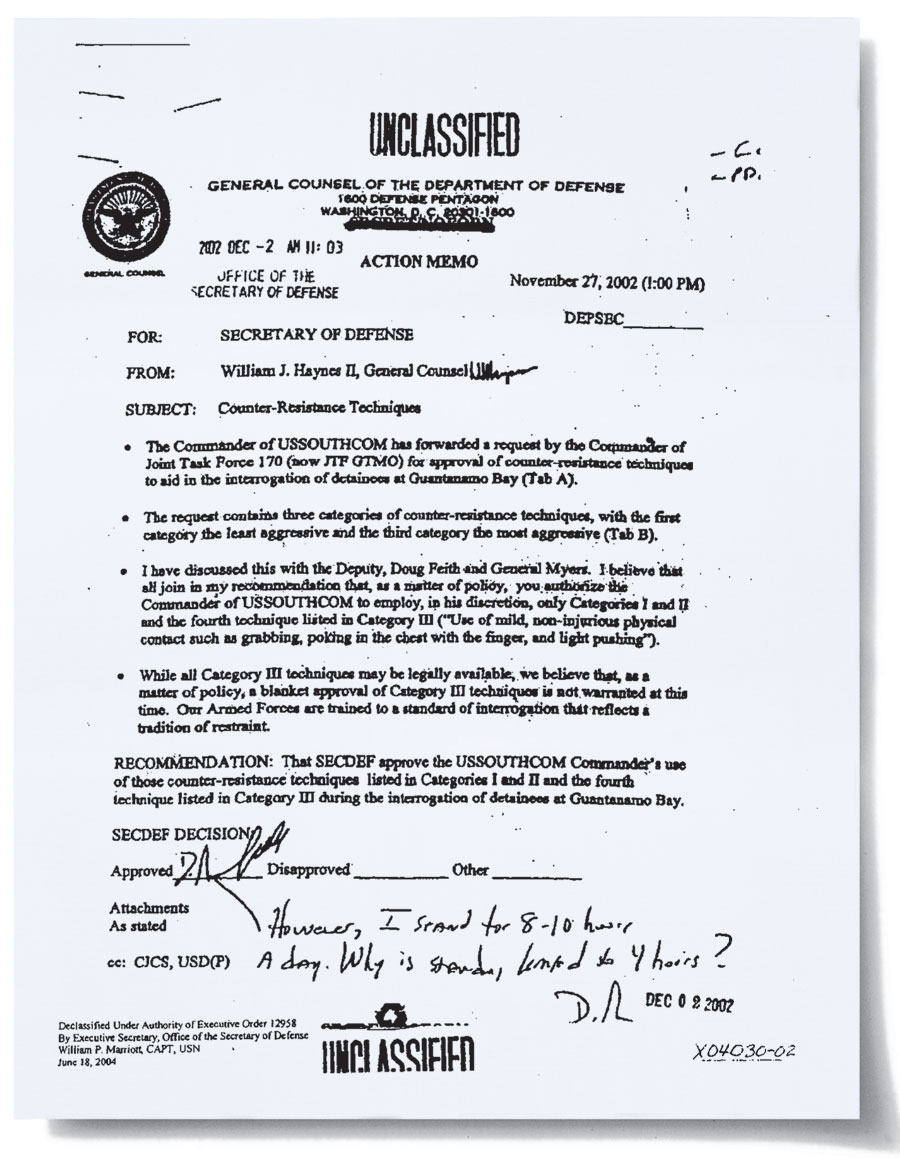
When the Haynes memo reached Guantánamo on December 2, Detainee 063 was in an isolated, plywood interrogation booth at Camp X-Ray. He was bolted to the floor and secured to a chair, his hands and legs cuffed. He had been held in isolation since August 8, nearly four months earlier. He was dehydrated and in need of regular hook-ups to an intravenous drip. His feet were swollen. He was urinating on himself.
During Detainee 063's first few months at Guantánamo, the interrogators had followed established practices for military and law enforcement interrogations. Building rapport is the overriding aim of the US Army Field Manual 34-52, the rule book for military interrogators, colloquially referred to as "FM 34-52". Legality was also essential, which meant operating in accordance with the rules set out in the US military's Uniform Code of Military Justice and international law, in particular the four Geneva conventions.
At the heart of them lies "Common Article 3", which expressly prohibits cruel treatment and torture, as well as "outrages upon personal dignity, in particular, humiliating and degrading treatment". Tactics that had conformed to these principles changed dramatically. The interrogation log describes what happened immediately after Rumsfeld signed the Haynes memo.
The pattern was always the same: 20-hour interrogation sessions, followed by four hours of sleep. Sleep deprivation appears as a central theme, along with stress positions and constant humiliation, including sexual humiliation. These techniques were supplemented by the use of water, regular bouts of dehydration, the use of IV tubes, loud noise (the music of Christina Aguilera was blasted out in the first days of the new regime), nudity, female contact, pin-ups. An interrogator even tied a leash to him, led him around the room and forced him to perform a series of dog tricks. He was forced to wear a woman's bra and a thong was placed on his head.
• • •
Phillippe Sands, "The Green Light" (May, 2008)
I sat down with Feith not long after he left the government. He was teaching at the school of foreign service at Georgetown University, occupying a small, eighth-floor office lined with books on international law. He greeted me with a smile, his impish face supporting a mop of graying hair that seemed somehow at odds with his 54 years. Over the course of his career Feith has elicited a range of reactions. General Tommy Franks, who led the invasion of Iraq, once called Feith “the fucking stupidest guy on the face of the earth.” Rumsfeld, in contrast, saw him as an “intellectual engine.” In manner he is the Energizer Bunny, making it hard to get a word in edgewise. After many false starts Feith provided an account of the president’s decision on Geneva, including his own contribution as one of its principal architects ....
.... Douglas Feith had a long-standing intellectual interest in Geneva, and for many years had opposed legal protections for terrorists under international law. He referred me to an article he had written in 1985, in The National Interest, setting out his basic view. Geneva provided incentives to play by the rules; those who chose not to follow the rules, he argued, shouldn’t be allowed to rely on them, or else the whole Geneva structure would collapse. The only way to protect Geneva, in other words, was sometimes to limit its scope. To uphold Geneva’s protections, you might have to cast them aside ....
.... Feith’s argument prevailed. On February 7, 2002, President Bush signed a memorandum that turned Guantánamo into a Geneva-free zone. As a matter of policy, the detainees would be handled humanely, but only to the extent appropriate and consistent with military necessity. “The president said ‘humane treatment,’ ” Feith told me, inflecting the term sourly, “and I thought that was O.K. Perfectly fine phrase that needs to be fleshed out, but it’s a fine phrase—‘humane treatment.’ ” The Common Article 3 restrictions on torture or “outrages upon personal dignity” were gone.
“This year I was really a player,” Feith said, thinking back on 2002 and relishing the memory. I asked him whether, in the end, he was at all concerned that the Geneva decision might have diminished America’s moral authority. He was not. “The problem with moral authority,” he said, was “people who should know better, like yourself, siding with the assholes, to put it crudely.”
• • •
Elana Schor, "Torture victim's records lost at Guantánamo, admits camp general" (April 21, 2008)
The former head of interrogations at Guantánamo Bay found that records of an al-Qaida suspect tortured at the prison camp were mysteriously lost by the US military, according to a new book by one of Britain's top human rights lawyers.
Retired general Michael Dunlavey, who supervised Guantánamo for eight months in 2002, tried to locate records on Mohammed al-Qahtani, accused by the US of plotting the 9/11 attacks, but found they had disappeared.
The records on al-Qahtani, who was interrogated for 48 days - "were backed up ... after I left, there was a snafu and all was lost", Dunlavey told Philippe Sands QC, who reports the conversation in his book Torture Team, previewed last week by the Guardian. Snafu stands for Situation Normal: All Fucked Up.
• • •
The Guardian, "Interview with Phillippe Sands QC" (audio)
Subscribe to:
Posts (Atom)

 Posts
Posts

